Google and Believe Join Forces: The AI Revolution Reaches Independent Musicians
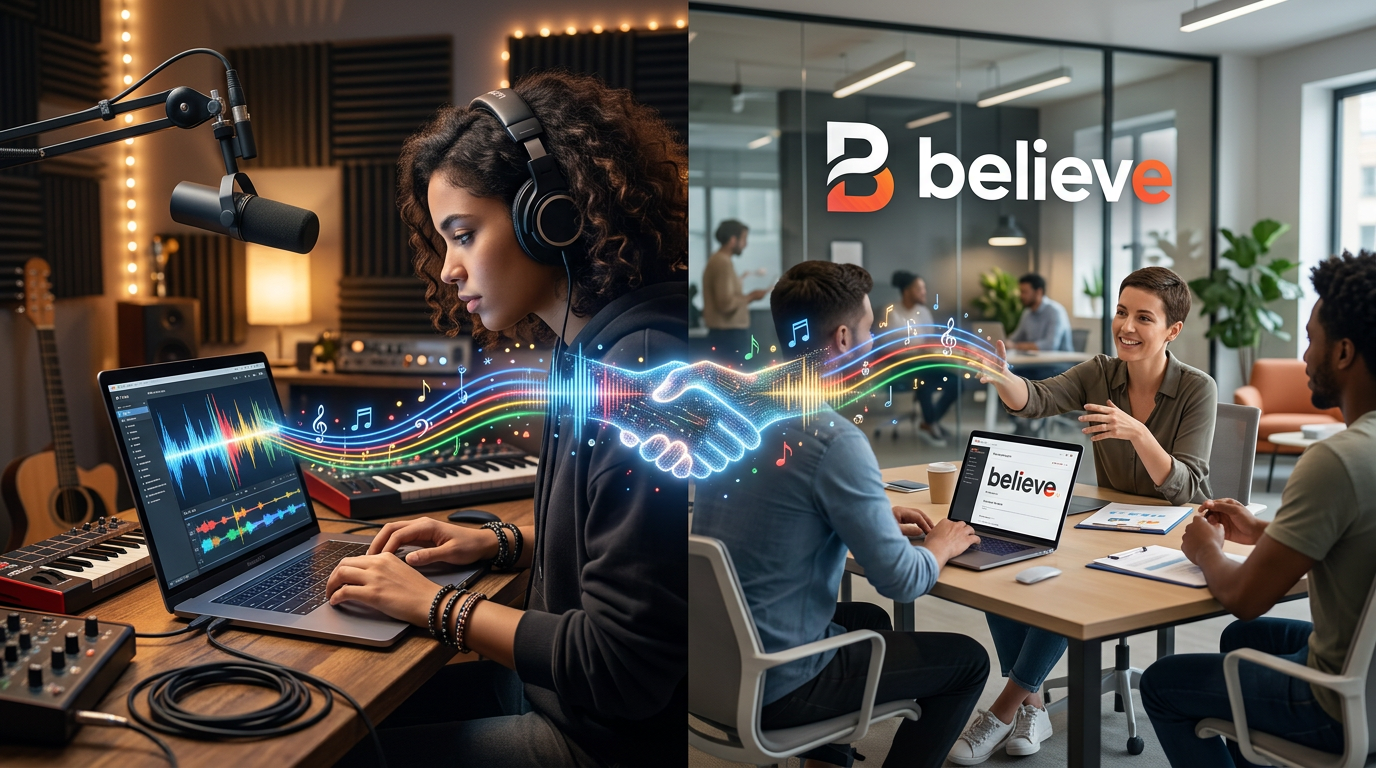
On May 6, 2026, the independent music industry received an unexpected technological boost. Google officially announced a strategic partnership with Believe — the global distribution giant that controls TuneCore. The agreement integrates Google’s AI tool, Flow Music, into the creative and production workflows of thousands of independent artists.
Both parties call this “the first major deployment of generative AI into the independent music infrastructure.” But behind the enthusiasm of engineers and executives, anxious voices from musicians are already emerging: will this “creative copilot” turn into a tool that devalues live craftsmanship? What Is Flow Music and Why Does Believe Need It?
Flow Music (originally code-named ProducerAI) is an AI assistant developed by Google Labs. Unlike flashy text or image generators, Flow Music focuses on narrow but critical musical tasks:
- generating melodic lines and chord progressions;
- creating bass lines and rhythmic patterns;
- suggesting arrangements in a given style;
- automatically transcribing raw ideas into notation and MIDI.
Google’s key positioning: the tool does not replace the musician but acts as a “copilot,” speeding up routine stages of work. However, it is precisely this “acceleration” that sparks debates within the professional community.
For Believe, the partnership is a move to retain independent artists. As the three majors (Universal, Sony, Warner) aggressively wrap AI developments into their branded label ecosystems, Believe needed an answer. Google provided one — perhaps at the cost of blurring the line between authentic authorship and machine generation.Deal Terms: Who Pays Whom and Who Gets What?
The parties have disclosed only the broad contours of the agreement:
| Element | Details |
|---|---|
| Access to AI | Artists on Believe and TuneCore get Flow Music via subscription (basic features free, advanced paid) |
| Rights to output | Fully owned by the musician — generation incurs no royalties to Google |
| Model training | Google does not disclose datasets. Believe states the model was not trained on label-owned catalogs without permission |
| Pilot | May–June 2026 (select TuneCore artists) |
| Full launch | Autumn 2026 for all Believe clients in the US, Europe, and Brazil |
The financial structure remains undisclosed. Analysts speculate a two-way flow: Believe pays for licensing the technology, while Google pays for access to anonymised creative process analytics.Market Reaction and Numbers
Investors welcomed the news with optimism. Believe’s shares (Euronext Paris) jumped 4.2% within hours of the announcement — against a broader European tech sector decline of 0.7%.
TuneCore saw a 35% surge in artist requests to join the pilot program within 24 hours. Believe has already expanded the quota from 500 to 1,200 slots.
Google typically does not disclose separate financial metrics for its music AI projects. However, an inside source at the company says Flow Music has been moved at Google Labs from “research” to “product with revenue KPIs” — signaling serious monetisation plans.What the Parties Are Saying
Google spokesperson (in a press statement):
“We built Flow Music to expand creative possibilities, not limit them. The partnership with Believe is a test of that philosophy in a real-world industry setting — among thousands of artists who are not forced to use AI but can choose to do so if they see the benefit.”
CEO of Believe (in an interview with Music Business Worldwide):
“Independent musicians have always been at the forefront of technological experimentation — from early DAWs to streaming. AI is no exception. Our job is to make sure technology works for the artist, not against them. Copyright and transparency are red lines.”
Key Risks and Criticism
Despite corporate optimism, three clear lines of criticism have already emerged within the industry.
1. Devaluation of manual craftsmanship.
“If any artist can generate hundreds of melodies in an hour — what happens to the perceived value of a composer who spent a week on a single arrangement?” asks Lauren Berkley, an independent producer from Nashville.
2. The training data black box.
Google does not disclose what data Flow Music was trained on. Even with Believe’s legal guarantees, many artists fear that their own releases uploaded to TuneCore could have ended up in the training set.
3. Economic pressure.
In the long run, labels (including Believe) may start encouraging or even requiring AI usage to cut production budgets. Officially this is denied, but precedents exist in adjacent creative industries.What Comes Next: Scenarios
Optimistic: AI becomes a standard plug-in, like Auto-Tune in the 2000s. Musicians prototype ideas faster, freeing up time for conceptual work. New genres emerge — “hybrid music” where human and AI collaborate as equals.
Realistic: The tool takes hold in commercial music (advertising, library tracks, pop production), but remains marginal in niche genres (jazz, avant-garde, experimental indie). “No AI” certifications emerge, similar to organic labelling in food products.
Pessimistic: Lowered barriers lead to oversaturation with subpar content. Streaming algorithms begin ranking AI-optimised tracks above human-made ones — leading to a “music winter” comparable to the devaluation of stock photography after Midjourney.The Bottom Line
The Google–Believe partnership is both a technological breakthrough and a socio-economic experiment on an entire sector of the creative economy.
If for Google this is yet another real-world AI testing ground, for Believe it is a bet on survival in a world where the majors are already pulling the AI blanket over to their side. Independent artists find themselves caught between two fires: the chance to accelerate versus the risk of becoming cogs in a cheap-content machine.
The answer to the main question — “does AI make music better?” — is still unknown. But one thing is already clear: after May 6, 2026, making music the old way, completely without AI, will soon become a political and aesthetic statement, not just a habit.