Velvet Sundown: The Rock Band That Isn’t. How a Hoax Exposed the Truth About AI in Music
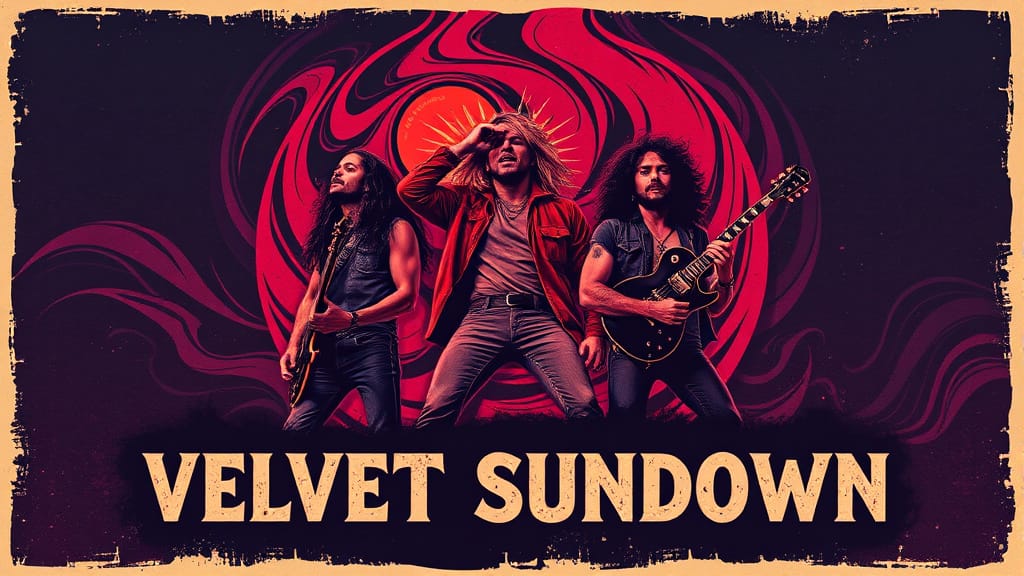
In 2025, the music world was confronted with a mystery that divided listeners and forced the industry to once again ponder the future. The band Velvet Sundown—a collective with a quality sound, nostalgic for 70s Southern rock, with live members and two suddenly released albums—turned out to be not what it seemed. Behind this project stood no vocalist, no guitarist. The sole and full-fledged “member” was artificial intelligence.
Sudden Appearance and First Suspicions
According to initial data picked up by media outlets like Euronews, Velvet Sundown consisted of vocalist Gabe Farrow, guitarist Lennie West, bassist and synth player Milo Rains, and drummer Orion “Rio” Del Mar. In June 2025, the group debuted on Spotify with two albums at once—”Dust and Silence” and “Floating on Echoes.”
Success was rapid. The track “Dust on the Wind” garnered millions of streams. However, the triumph was marred by growing skepticism. Reddit users were the first to sound the alarm: Velvet Sundown’s songs were actively appearing in their algorithmic “Discover Weekly” playlists, yet it was impossible to find any information about the band outside of streaming platforms. There were no live performances, interviews, old photos—nothing.
A Hoax Within a Hoax
The situation became absurd when, in late June, a person using the pseudonym Andrew Frelon appeared. He created a fake account on X and began posing as a band representative. He even managed to fool outlets like Rolling Stone, which took comments from him. This was a cunning trick: Frelon intentionally exploited the information vacuum to demonstrate how easily the media falls for a “hot” story, neglecting basic fact-checking.
The Revelation: “This is not a trick, it’s a mirror”
On July 3, 2025, the veil of secrecy was lifted. A statement appeared on Velvet Sundown’s official social media pages. The collective admitted to being a “synthetic music project, guided by human creative direction, but composed, sung, and visualized with the support of artificial intelligence.”
“This is not a trick,” the statement read, “it’s a mirror. An ongoing artistic provocation designed to challenge the boundaries of authorship, identity, and the future of music itself in the age of AI.”
That same day, Frelon published a post on Medium explaining his motives. He stated that his hoax exposed “numerous and significant gaps in the verification process used by the majority of journalists.”
What Does This Mean for Music? The Experts’ Voice
The story of Velvet Sundown is not just a curious case. It became a catalyst for important conversations about AI’s role in creativity.
- AI as a Tool for Accessibility. Specialists, such as those from Berklee College of Music, note that AI democratizes music production. Now, those without access to a studio or who are limited by their distance from music hubs or health conditions can create music.
- The Blurring Line. Distinguishing AI-created music from human music is becoming increasingly difficult. Early versions could be given away by a “watery” sound or simplified, “greeting-card” style lyrics. But today, the difference is fading. Experts draw a parallel with samplers and synthesizers: AI is a tool, not a genre.
- The Legal Battle. The main issue is training neural networks on works without the authors’ consent. Professor George Howard warns that although copyright laws formally apply to AI as well, the industry must aggressively protect artists’ rights to prevent the “continued eradication of the chance of sustainability for the vast majority of musicians.”
Epilogue: The Rebellion Continues
Despite the exposure, the Velvet Sundown project did not cease to exist. On July 14, the band, or rather the team behind it, released a third album—”Paper Sun Rebellion.” Their songs continue to amass millions of streams.
Velvet Sundown proved that in the age of AI, the important question is no longer “Who made this?” but “How was it made?”. The project became a living manifesto, a provocation, and a warning. It showed that algorithms can generate not just generic music, but full-fledged artistic myths that force us to reconsider the very nature of creativity. Their rebellion against traditional notions of authorship is just beginning.