AI Holograms Hit the Campaign Trail: Indian Student Creates Politician’s Double in 3 Days
In the Indian state of Tamil Nadu, an unusual technological experiment unfolded ahead of the 2026 elections. To cover more than 200 constituencies, the fledgling TVK party replaced its live candidate with a holographic double. The most interesting part is not the technology itself, but who created it and how quickly.
The Challenge: Being Everywhere at Once
Ahead of the Legislative Assembly elections scheduled for April 23rd, the party Tamilaga Vettri Kazhagam (TVK) faced a classic problem for a growing political force. Their leader—popular actor and politician Vijay—physically could not visit every corner of the state during the campaign sprint.
The party headquarters tried traditional methods: mannequins resembling Vijay appeared at rallies, as did live look-alikes. However, the sense of presence was weak, and voter enthusiasm remained lukewarm. They decided to go all-in on artificial intelligence.
Student, Fan, and 50 Seconds of Magic
The most surprising aspect of this story is not the campaign budget but the contractor. The task was not assigned to a major IT giant or an expensive production house, but to 20-year-old third-year student Pravin K. , who studies Artificial Intelligence and Data Science.
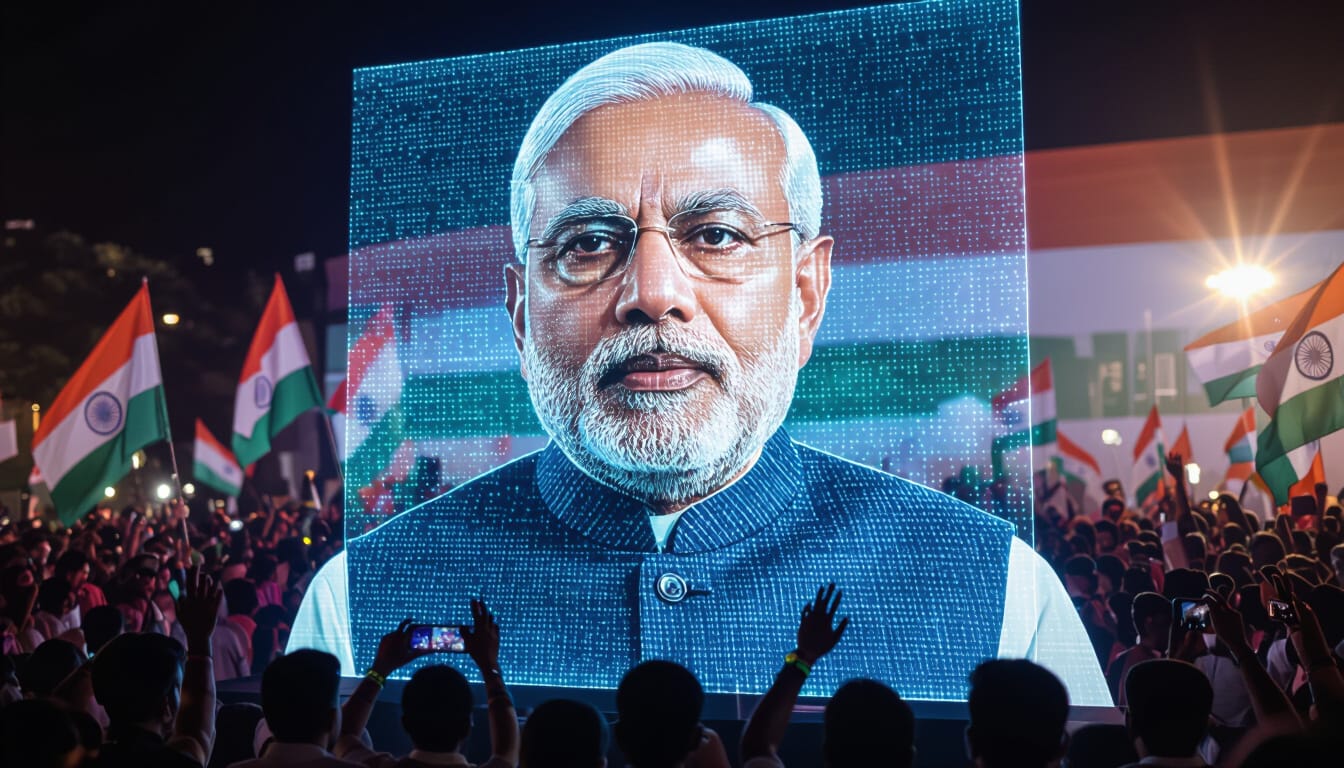
Pravin used a 50-second video clip featuring the politician’s speech. Using machine learning algorithms, he synchronized the image with archival audio recordings of Vijay’s past addresses. The video was then converted into a format suitable for projection on a 3D fan display.
The choice of fan technology was deliberate. Unlike classic translucent screens, this device creates a brighter, more dimensional image that remains clearly visible even in daylight as the campaign vehicle moves through the streets.
Just three days passed from receiving the technical assignment to the first test screening.
The Element of Surprise and “Resurrecting” Legends
The first outing took place on April 12th in the Kumbakonam constituency. The hologram, mounted on a car roof, delivered a short but fiery speech. Witnesses reported that many passersby initially believed they were seeing the politician in person and only realized they were looking at a projection upon closer inspection.
The public reaction was so intense that the video of “Hologram Vijay” instantly went viral across social media. This led to unexpected consequences for the contractor, Kaamaa Technologies.
As soon as the clips went viral, the company was flooded with unusual orders. Political forces of various levels began requesting similar avatars of deceased political legends of the state, such as M. Karunanidhi and J. Jayalalithaa, so that they too could “participate” in the campaign.
How Much Does a Digital Rally Cost?
The pricing for such services proved to be very flexible and affordable even for small regional party branches.
- Student’s Estimate: Pravin K. estimated the cost of content production and equipment rental for the campaign at approximately 2-3 lakh rupees (equivalent to $2,400 – $3,600 USD). This is comparable to the cost of renting a decent banquet hall for an evening.
- Commercial Offer: Kaamaa Technologies cited even more affordable figures. According to them, the cost of one day of holographic campaigning starts at 50,000 rupees (about $600 USD).