From Canvas to Cosmos: How Ai-Da the Robot Became AI’s First Architect
Aalborg, Denmark — London, 2024–2026
In January 2026, at Denmark’s Utzon Center — a building designed by Jørn Utzon himself, the creator of the Sydney Opera House — an exhibition titled “I’m Not a Robot: Architecture and Design Between Human and Machine” opened. The main exhibit sparked as much debate as the exhibition itself: a full architectural project for a residential building, developed by a robot.
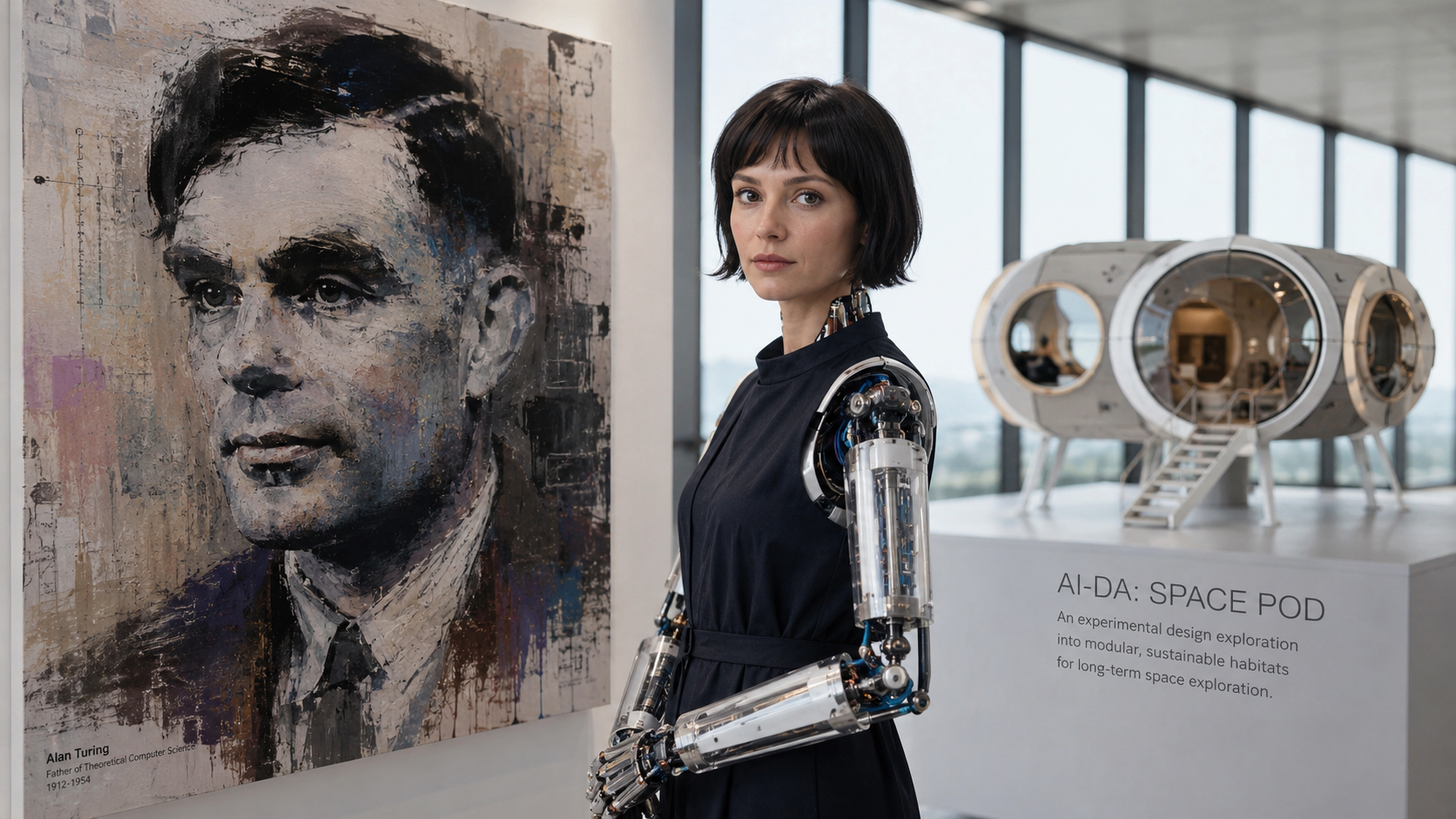
The author is Ai-Da, the world’s most famous robot artist. Her journey from painting portraits to designing buildings for the Moon and Mars is a story of how technology is gradually blurring the line between executor and creator.
Who Is Ai-Da and Why Did Sotheby’s Take Notice?
Ai-Da is a humanoid robot created in 2019 in Oxford by a team of engineers and art theorists led by gallerist Aidan Meller. She was named after Ada Lovelace — the 19th-century mathematician regarded as the world’s first programmer.
But it was her output, not her biography, that brought her fame. In November 2024, Ai-Da’s painting “A.I. God” — a portrait of computing pioneer Alan Turing — was put up for auction at Sotheby’s. Experts estimated the work at $120,000 -180,000. The final price nearly $1,082,500.
It was the first time in history that a work created by a humanoid robot was sold at a major auction. Auction house staff called the moment “an important milestone in the history of modern and contemporary art.”How Does a Robot Paint?
The process by which Ai-Da creates a painting is radically different from both human painting and AI image generation. While ideas for her works emerge in dialogue with her team, the technical execution belongs to the robot:
- Vision. Cameras embedded in Ai-Da’s eyes scan the subject.
- Brain. Computer vision algorithms convert what she sees into movement trajectories for her robotic arm.
- Hand. The robotic limb transfers the image onto canvas.
The 2.2‑meter‑tall portrait of Alan Turing was executed in mixed media on canvas. According to Ai-Da’s creator Aidan Meller, the “soft tones and fragmented facial features” contain a subtle warning about the future problems of controlling artificial intelligence — a concern Turing himself once raised.
2026: The First Architectural Project by a Robot
“This event opens a new chapter in Ai‑Da’s history — from drawing to architectural design,” her team announced in January 2026, presenting Ai-Da: Space Pod at the Utzon Center in Denmark.
The project is a modular residential complex designed to function not only on Earth but also in extreme environments — the Moon or Mars.Architecture: Retro-Futurism for Humans and Machines
The design of Space Pod draws on the space aesthetics of the mid‑20th century:
- Rounded forms and large porthole‑style windows, reminiscent of futuristic homes from the 1950s and 60s.
- Two living zones for humans, connected by a spiral staircase.
- A small service area that could serve as a kitchen or bathroom.
- A smaller module inside the main structure — a dedicated rest space for a robot.
“The project envisions the cohabitation of humans and robots in isolated environments, where adapting the space to the needs of both types of inhabitants becomes a key challenge,” explains the concept.Technology: From Digital to Canvas and Back
The project evolved through several stages, each demonstrating Ai‑Da’s capabilities as an independent creative unit:
- Digital concepts — generated by AI creative systems.
- Physical sketches — transferred to paper using the robotic arm.
- Detailed paintings — executed with the technique refined on the Turing portrait.
- Digital visualizations — of interiors and exteriors for the final presentation.
“The result shows the robot as an independent creative force that collaborates with people, raising questions about creativity, authorship, and changes in artistic identity,” the Ai‑Da team summarizes.
What Does Ai‑Da Herself Say? (And Her Creators)
At the project’s launch in Denmark, Ai‑Da’s team released a statement on behalf of the robot, which reveals much of the project’s philosophy:
“As humanity looks beyond Earth, we must also think about how to take care of the world we already share. Conversations about space are crucial, especially when it comes to building positive relationships between people and technology. That is why I am glad that my concept for a home‑studio for the Moon or Mars is presented at the Utzon Center — a space where new ideas can arise, be explored, and be discussed together.”
Aidan Meller, Ai‑Da’s creator, adds:
“Technology is evolving at an incredible pace. Emotion recognition through biometrics, CRISPR gene editing, brain‑computer interfaces — all of this holds immense potential, but also raises profound ethical questions. Ai‑Da stands as a mirror of our time and calls on us to think critically about the future we are building.”
Line Nørskov Davenport, exhibition director at the Utzon Center, speaks even more directly about the robot’s role:
“Ai‑Da is confrontational. The very fact of her existence is confrontational. And that is exactly why she is interesting and worthy of being presented in a broader cultural and technological historical context. She is a wake‑up call for the AI world, an initiator of conversation.”
Controversies: Art, Authorship, and Anthropomorphism
Despite her success, debates around Ai‑Da never die down. Critics frequently raise the same questions:
- Who is the real author? How independent is Ai‑Da if her ideas emerge in dialogue with her team?
- Does anthropomorphism mislead? By giving the robot a female face, a name, and a voice, the creators lead viewers to attribute consciousness to an AI that does not possess it.
- Can a machine create? Or is this the most expensive performance art of the 21st century?
Meller’s answer is simple and pragmatic: “No one would discuss just a piece of software. That’s boring. But give it a personality — and suddenly everyone starts talking about AI ethics.”
And it works. The exhibition in Denmark runs through October 2026. Ai‑Da will continue her journey: after Denmark, the Space Pod project will be presented in London.