Light vs. Silicon: UK Startup Lumai Unveils Optical AI Server That Consumes 90% Less Energy
The world is rapidly entering an era that technology analysts have already dubbed the “AI energy crisis.” The forecasts are grim: by 2030, the electricity consumption of data centers could double, driven precisely by the colossal computational loads required for training and running neural networks. Against this backdrop, the news from the Oxford-based startup Lumai looks less like a mere technological breakthrough and more like a lifeline. On April 28, 2026, the company officially unveiled the Iris Nova — the world’s first optical computing server for AI inference.
The Silicon Dead End and the Light-Based Exit
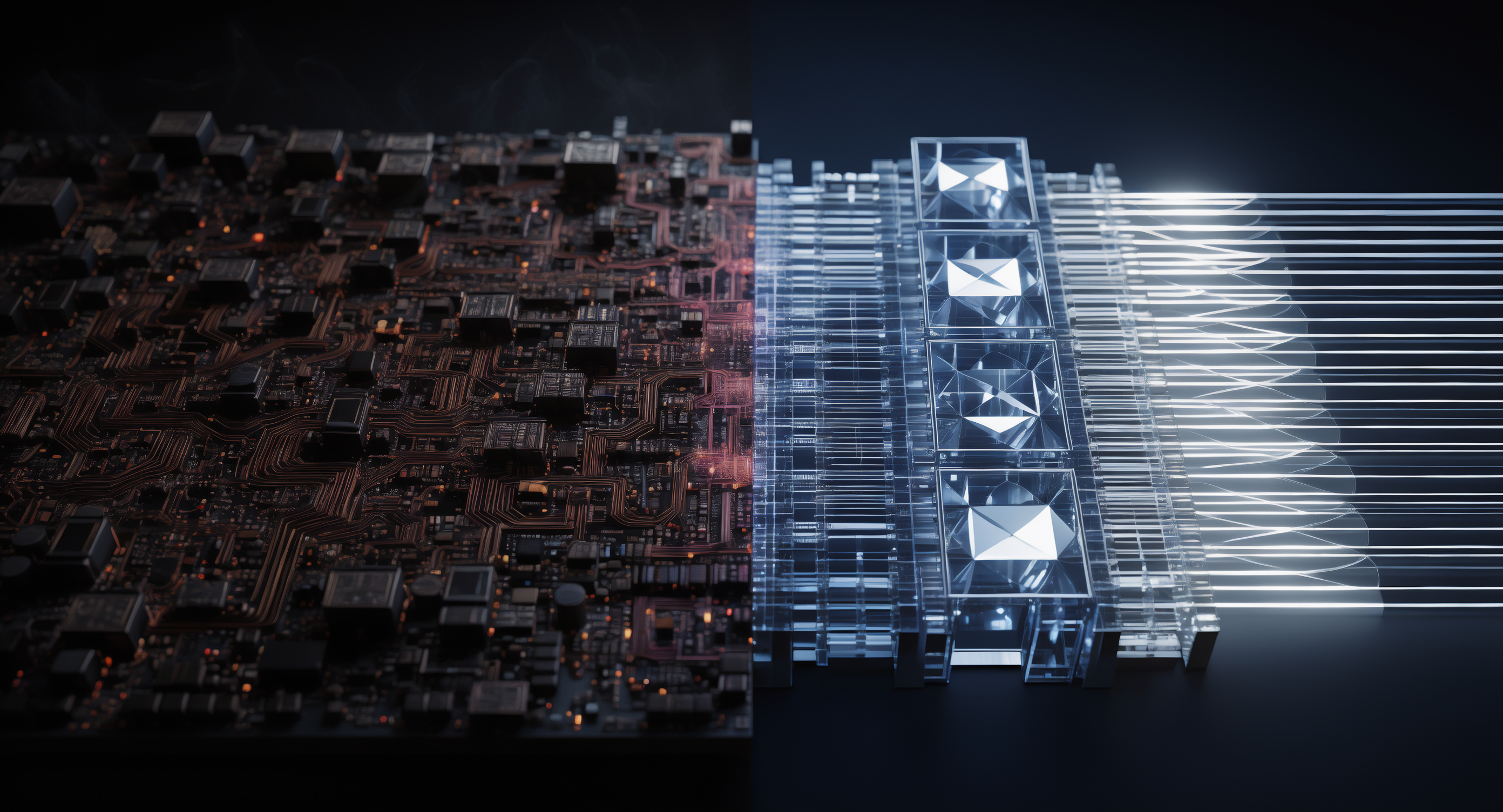
Traditional processors and graphics accelerators (GPUs) have run on electricity for decades, but their efficiency is hitting up against the physical limitations of two-dimensional silicon wafers. Lumai has proposed a radically different approach: replacing electrons with photons. Their technology uses light to perform the mathematical operations underlying neural network function.
The key element of the Iris Nova is its optical tensor engine. Instead of the sequential calculations characteristic of electronics, it processes data in parallel within three-dimensional space. Laser beams pass through a system of lenses and a special high-speed display where the model’s weights are encoded (the so-called matrix multiplication). This “spatial parallelism” allows for millions of operations to be performed simultaneously, delivering unprecedented performance.
Record-Breaking Savings and Immense Power
The results are impressive even to skeptics. The developers claim a 50-fold increase in performance compared to the best modern GPUs, while simultaneously reducing energy consumption by 90%. The Iris Nova is no longer a lab prototype but a ready-made server solution, tested on current large language models like Llama 8B and 70B.
The server architecture is hybrid: the optical part handles the most resource-intensive mathematics, while a traditional central processor manages the system and performs auxiliary operations. This ensures compatibility with existing data center infrastructure, allowing the new hardware to be seamlessly integrated into current workflows.
“We are officially entering the post-silicon era,” stated Lumai’s leadership. “Optics provides a real path for scaling AI without a colossal strain on power grids.”
From Nova to Tetra: Plans for the Future
The startup does not intend to stop at a single model. The newly presented Iris Nova is already available for testing by major cloud providers and research institutions, with the deployment of the first test clusters expected by the end of 2026. Next will be the Iris Aura — a computing rack combining several optical engines. By 2029, the company plans to launch the Iris Tetra — a system for large-scale cluster deployments with a performance of 1 exaOPS while consuming only 10 kW of power.
The news from Lumai is not just another engineering victory. It is a signal to the entire industry that a solution exists to the looming energy crisis caused by the widespread adoption of AI. If the shift from electrons to photons becomes economically viable on the mass market, it will fundamentally alter the economics of data centers and slow the growth of the tech sector’s carbon footprint. The artificial intelligence of the future may well run not on silicon, but on light.