
One Man Army: How a 29-Year-Old Self-Taught Creator from Yunnan Turned the Film World Upside Down in 10 Days with 3,000 Yuan
May 2026 will go down in history as the moment when the formula for success in cinema cracked. While Hollywood studios spend millions of dollars and years on production, a 29-year-old wedding photographer from China’s Yunnan province single-handedly, in ten days, and with a budget of 3,000 yuan (about $440), created a short film that conquered the world. The story of Liu Ziyu and his “Zombie Scavenger” is now being discussed from Los Angeles to Shanghai.From Wedding Photos to “Atomic Punk”
If there were a textbook titled “How a Future Conqueror of Hollywood Should Not Look,” Liu Ziyu (known online as Mx-Shell) would serve as an illustration for every chapter. A vocational diploma in “operation and repair of diesel locomotives,” a job at a railway company, then a return to his native Yunnan, where he took up wedding photography and shooting commercials for the family hotel business.
He first encountered AI video only at the end of January 2026 — and even then, by accident. The family hotel was under renovation, a promotional video needed to be made, but there was nothing to shoot: only design projects and renders. “Turning pictures into a TikTok slideshow is a bad idea,” Liu reasoned, and he tried to “bring to life” static images using neural networks. Thus began the path that would lead him to worldwide fame just a few months later.
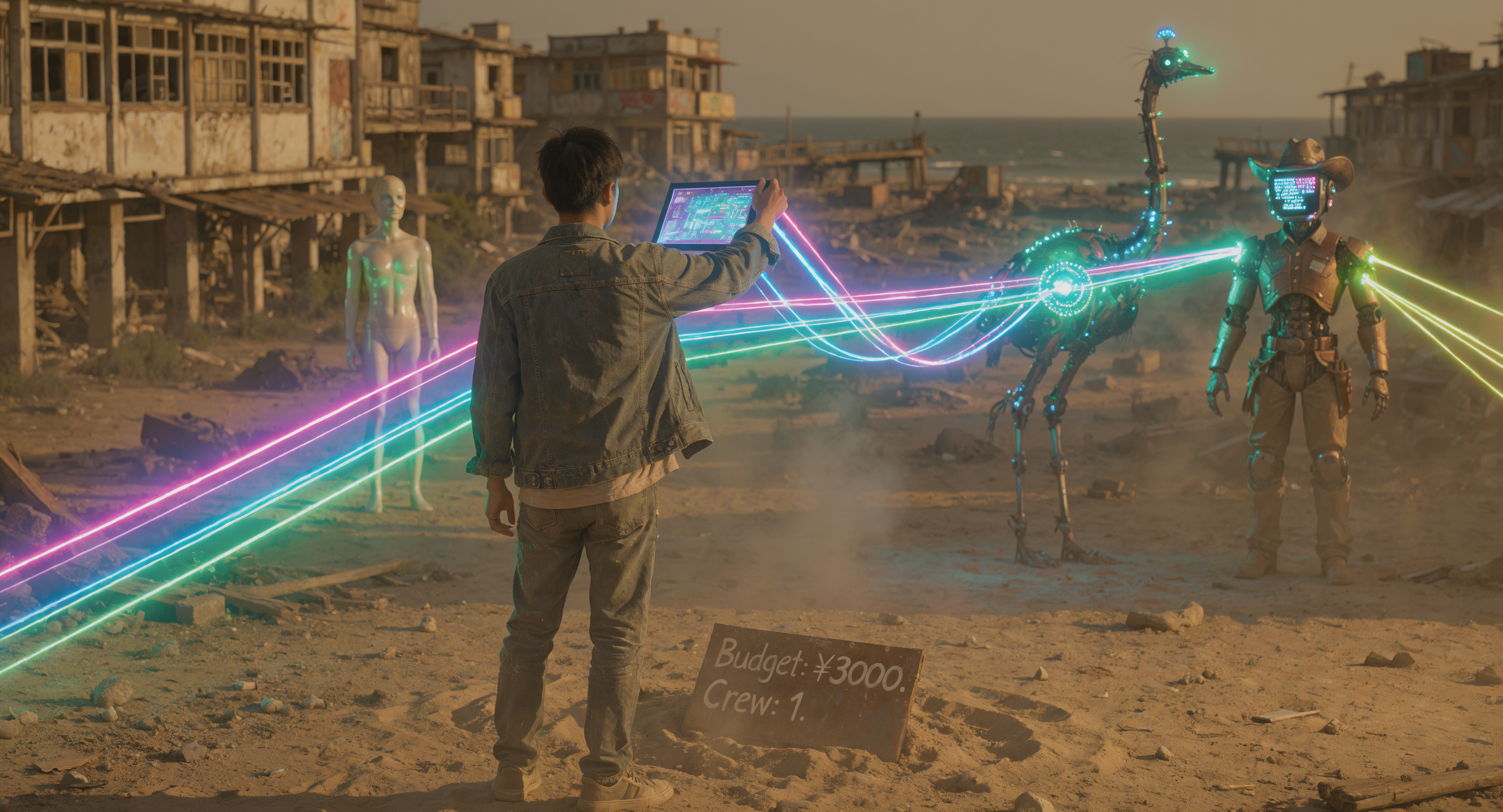
He defined his style immediately: no cyberpunk. “Everyone does cyberpunk, it’s boring,” Liu explains. He chose atomic punk — a retro-futuristic aesthetic inspired by the world of the Fallout game series. A robot cowboy with an LED screen for a face, a post-apocalyptic seaside town, zombies, an ostrich instead of a horse, and a plastic mannequin as a lover — this whimsical cocktail of western, horror, and black comedy became “Zombie Scavenger.”10 Days That Shook the Industry
The film’s budget came to roughly 3,000 yuan — the money went toward paying for computing power (tokens) on ByteDance’s Seedance 2.0 platform, which Liu used as his primary tool. For comparison: Hollywood producer PJ Ace, who first noticed the film, calculated that before the advent of AI, producing a video of comparable quality would have required more than $500,000 and six months of work.
Liu’s workflow looked like this:
- Days 1-2: Concept and script. Although “script” is a strong word. “At first, I didn’t have a story at all; I was just connecting everything I wanted to see,” he admits. A full script appeared only after the film was finished.
- Days 3-4: Generating storyboards through Seedance 2.0’s “immersion mode.”
- Days 5-7: Main video generation. This is where what Liu calls a “death struggle” began.
- Days 8-9: Sound and voiceover. Here Seedance 2.0 offered an unexpected advantage: the model generates sound synchronously with video — gunshots, footsteps, the screech of metal appear immediately, without the need to source them manually.
- Day 10: Final editing in CapCut Pro.
“I Am the Director, AI Is the Actor”: The Philosophy of a Solo Creator
The most telling episode is the creation of the scene where the robot ostrich trips over a coconut palm. This single shot took about two hours of continuous work. Liu’s requirements were extremely specific: a seaside town, a straight street, shops on both sides, a bus by the roadside, a palm tree fallen onto the bus, and a clothing store display behind the palm. “You specify all of this, and either the positioning is correct but the image is ugly, or the image is beautiful but the positioning is wrong,” he explains. In the end, the shop sign came out mirrored (the letter F was facing the wrong way) — Liu waved his hand and fixed it in post-production.
This is his entire method in a nutshell: “If it doesn’t work — change the prompt. If it really doesn’t work — compromise and mask the flaws in editing.” He calls it a “death struggle” and believes that it is precisely the willingness to fight for every frame that distinguishes a true author from someone who simply “pressed a button and waited.”
At the same time, Liu fundamentally does not use ready-made storyboards. Instead of rigid instructions, he gives the model “freedom”: “If you don’t squeeze it into a box, it sometimes produces things I would never have thought of myself.” That moment with the newspaper sticking to the ostrich’s leg — pure improvisation by the neural network: Liu merely specified “the ostrich is uncomfortable,” and the model built an entire chain of actions — shaking the leg, jumping, throwing it off.
And one more important detail: in the film’s credits, Liu lists every AI model used, just as traditional films list actors and crew members. “I don’t consider AI a tool. It’s a team member,” he says.Hollywood Searches, Liu Replies: “I Don’t Speak English”
On May 10, 2026, PJ Ace, a Hollywood producer with over three billion total views across his projects, posted an enthusiastic message on X: “This is one of the best short films I’ve seen in recent years. Soon we will stop calling this ‘AI cinema’ — it’s just cinema.” And he announced a search for the creator.
Chinese users rushed to Liu’s comments with the news: “Hollywood is interested in you!” At first, he didn’t even understand who this PJ Ace was. And when he did — he honestly answered with his very first phrase: “I don’t speak English.”
The six letters they exchanged are non-binding. PJ Ace proposed collaboration in Los Angeles. Liu politely declined: he does not plan to move to the US, but “now I have a friend in Hollywood.” Meanwhile, commercial success was not long in coming: Chinese company Qingqiu Culture acquired the rights to a feature-length adaptation, and Yoroll studio will handle the game version.What Comes Next
Now, as the hype around “Zombie Scavenger” begins to subside, Liu Ziyu says surprisingly sober things. He does not intend to “rest on his laurels” and understands that one viral video is not yet a career: “Let me make my next work, and then judge — whether I deserve all this attention.”
And perhaps the most unexpected detail — his attitude toward the technology that made him famous: “Even if everyone knows me thanks to AI, I am not on the side of AI. If I had the chance — I would want to really pick up a camera, write a script, and shoot a film. To become a real director.”
A budget of three thousand, ten days, zero professional education — and a world that will never be the same. It seems the formula of “one person — one film” has just stopped being a metaphor.