
The Label That Blinds: How “Inverse Presence” Made the Crowd Trash a Real Monet While Hunting for AI
The story of the fake Monet, which we discussed earlier, has received a serious scientific analysis and an unexpected financial finale. Researchers have introduced a new term — “inverse presence” — and the author of the experiment has turned the moment of collective self-exposure into an NFT worth $40,000. Here is how the story concluded.“Inverse Presence”: How Science Explains It
The forgery story turned out to be only the first chapter. Researchers from the International Society for Presence Research (ISPR) published an analysis of the viral experiment, introducing the term “inverse presence” into circulation.
The essence of the phenomenon is this: the classic “presence effect” makes the viewer emotionally immerse themselves in a virtual environment, perceiving it as real. Here, everything is reversed — the “made by AI” label forces a person to distance themselves from genuine art and see it as a soulless fake.
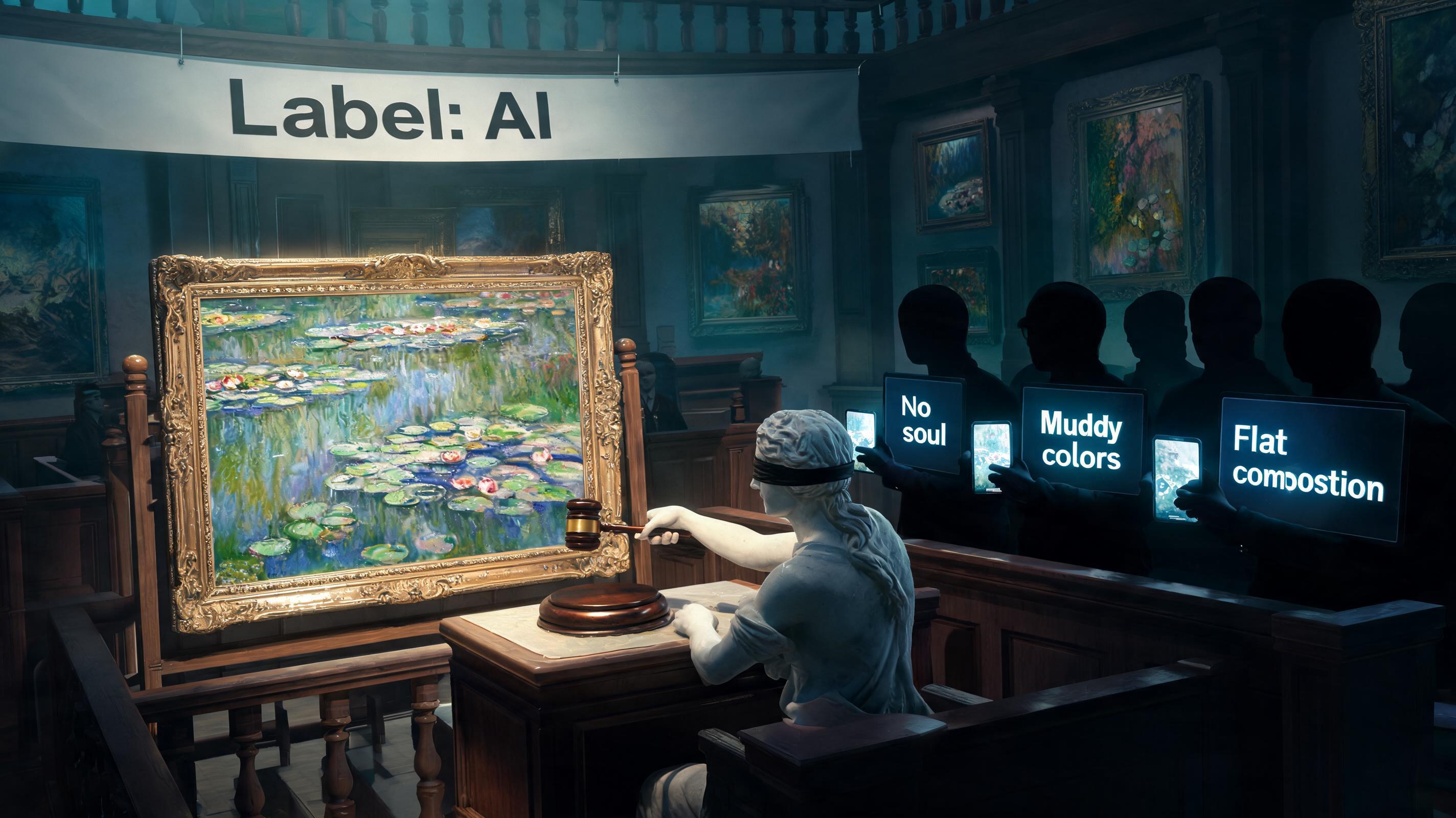
The experiment was staged by an anonymous artist under the handle @SHL0MS. They took one of the 250 paintings from the “Water Lilies” series (painted around 1915 and housed in Munich’s Neue Pinakothek), cropped out Monet’s signature, and posted it on X with the label “Created with AI.” The result: over 600 scathing comments and more than 2.3 million views.What the “Experts” Wrote
Critics, confident they were exposing a neural network, did not mince words:
- On composition: “No depth, no contrast, no coherence — everything is flat and talentless.”
- On color: “The purple outline around the water lilies is an obvious neural network glitch, Monet would never have allowed himself that.”
- On “soul”: “It evokes no feelings — just colorful wallpaper.”
- The most epic: One participant wrote an 850-word essay with a detailed analysis of the “defects” and illustrations of the “incorrect” composition.
When the deception was revealed, many deleted their comments. But SHL0MS and other users had already taken screenshots — now they are spreading across social media as an example of how bias works.What Lies Behind It: Interview with the Author and Scientific Data
In an interview with OpenSea, the author of the experiment explained their intent:
“The AI label grants social permission to disengage critical thinking. Once people decided it was AI — their standards of critique collapsed. A confidence emerged that they had absolutely no right to possess.”
They deliberately chose a painting that the average person vaguely recognizes (“Monet — yes, but ‘Starry Night’ — that’s Van Gogh”). This created an illusion of competence: everyone knows what a Monet “should” look like, but no one recognizes the specific work.
Science confirms this: a 2026 Tilburg University study analyzing 191 works from 2017–2024 showed that the mere fact of attributing a work to AI lowers aesthetic evaluation on all three levels — visual (“the colors are duller”), semantic (“less creativity”), and emotional (“it doesn’t move you”).Historical Irony
Art historians have also noted an ironic twist: the exact same reproaches — “unfinished,” “muddy colors,” “poor composition” — were hurled at Monet and his fellow Impressionists in the late 19th century by the academic critics of the time.
History has come full circle: a hundred years ago, these “shortcomings” were considered proof that the Impressionists were unserious artists. Today, the same complaints are leveled at artificial intelligence.Finale: NFT for $40,000
As a concluding gesture, the author turned the painting into an NFT titled “Inferior Image.” After 28 bids, the lot sold for just over $40,000. According to SHL0MS, this was not a pointer to a work of art, but to the very moment of collective self-exposure — the buyer was acquiring “ownership rights to this story.”