
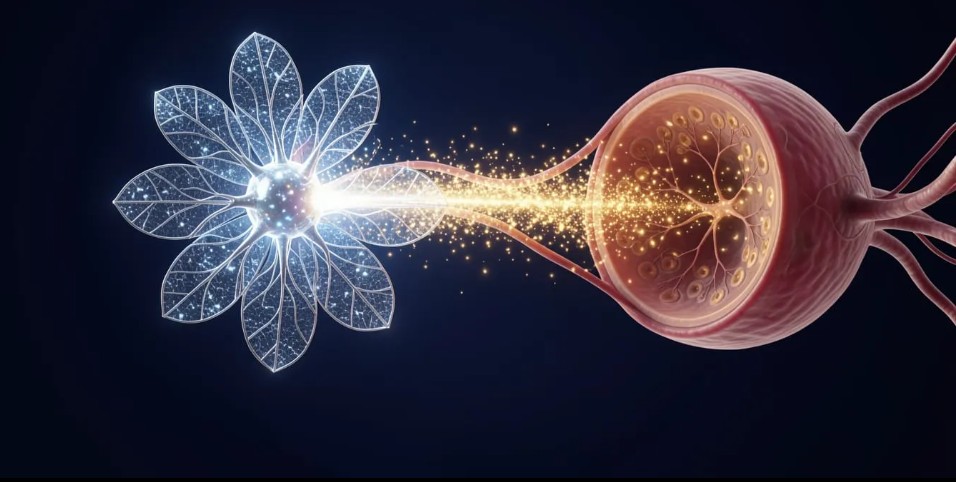
Scientists Create Tiny Chips That Talk to the Brain Like Real Neurons
Engineers at Northwestern University have made a technological breakthrough that once seemed like science fiction. They have created artificial neurons that can talk directly to a living brain almost as if they were the real thing.
Modern implants and bionic prosthetics (like hearing aids or heart stimulators) work in a rather rough way. They either just “shock” the tissue or send signals that are too simple. Imagine someone playing a piano using only a hammer. It’s loud and clear, but very unnatural.
The Northwestern artificial neurons work differently. They mimic the biological brain so accurately that living nerve cells cannot tell the difference.
Inside a normal microchip, electrons run along a smooth, clean path. It’s very fast, but too simple for the brain.
In the new device, scientists deliberately created a little bit of “mess” — they left some disorder inside the material. When electricity flows through this mess, it trips, gets delayed, and finally produces not just a simple “on/off” signal, but a beautiful, natural-looking pulse — like a sunset on a graph.
The biological brain recognizes this “fragile” signal as its own.
To prove this wasn’t just a toy, the scientists connected their chip to a real slice of a mouse’s brain.
Then something amazing happened. The living mouse cells, which are used to talking to each other in complex codes, accepted the stranger. When they saw the signal from the artificial neuron, they immediately activated and began passing the signal along. They thought it was one of their own.
For science, this is like a foreigner not only reading English words but speaking to a British person with a perfect Cambridge accent.
Right now, this is just a lab experiment, but it has two huge real-world applications.
First, medicine and bionics. Today, a paralyzed person cannot feel their legs. Tomorrow, with these neurons, scientists could build a “bridge” at the point of a spinal cord injury. This could mean super-accurate hearing implants that let you hear music, not robotic beeps. Or prosthetic arms and legs that obey your thoughts instantly and smoothly, like real limbs.
Second, super-efficient AI and computers. Your phone or ChatGPT uses a lot of battery because the processors are very hungry for power. The human brain uses as much energy as a small fridge light bulb. These new neurons could become the basis for neuromorphic computers — computers that work “like a brain.” They would think faster and could be charged once a month.
The research was published in the serious scientific journal Nature Nanotechnology. This is not a fake or a fantasy. This is real technology proving that creating an artificial copy of a brain cell is possible.
Of course, it will take years of testing before we can implant such chips into human heads. But the first step has been taken: a machine has started speaking the language of the living body.