Sony’s Ace Robot Defeats Professional Players for the First Time in Historyv
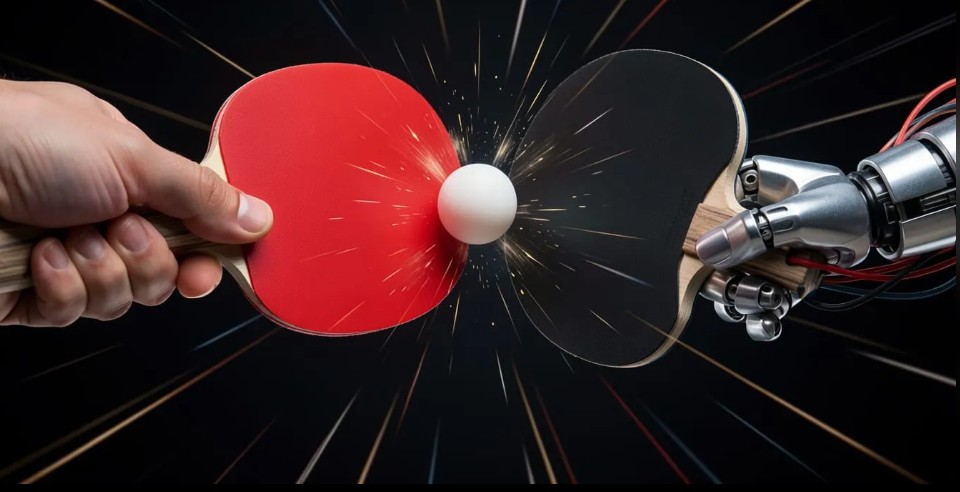
A robotic arm named Ace, developed by Sony’s artificial intelligence division, has become the world’s first robot to reach an expert level in a physical sport. The study, published in the prestigious journal Nature, describes how a bulky mechanism managed to outplay top athletes on their own turf.
TOKYO — Table tennis is one of the fastest and most technically complex sports in the world. The ball can travel at over 100 km/h, spinning with furious force, while the player has fractions of a second to make a decision. Until now, it was believed that a machine could not compete with a human under such conditions. The Ace robot has shattered that stereotype.
Built by engineers at Sony AI, Ace is a massive industrial arm with eight joints, mounted on rails along the table.
“Speed is one of the fundamental challenges in modern robotics, especially in environments that are not fixed,” explains Michael Spranger, President of Sony AI. “We see many robots in factories that are very fast, but they perform the same trajectory over and over again. Ace shows that robots can be trained to be adaptive and fast in a constantly changing environment.”
The secret to Ace’s success lies in its superhuman capabilities. While a human player relies on two eyes and intuition, the robot has nine synchronized high-speed cameras positioned around the court.
This system allows Ace to see what is invisible to humans: it tracks the position of the logo on the ball to calculate, in real time, the direction and force of its spin. To the human eye, such spin appears as nothing more than a blur.
At the same time, the developers deliberately limited the “hardware.” Spranger notes that building a “superhuman” robot that simply spits the ball out faster than a human can react is easy. But their goal was different:
“The goal is to achieve comparability, a certain level of fairness with humans, and to win through AI, decision-making, tactics, and skill — not brute speed.”
The robot learned to play not through rigid programming but through reinforcement learning. It conducted thousands of virtual matches against itself, developing optimal strategies through trial and error.
“It’s impossible to manually program a robot to play professional table tennis,” explains Sony AI researcher Peter Dürr. “It has to learn to play based on experience.”
The trials took place on an Olympic court at Sony’s headquarters in Tokyo, with official referees from the Japan Table Tennis Association.
The results are impressive. In official tests, Ace won three out of five matches against elite amateurs (players training at least 20 hours per week). But the most interesting developments came after the study’s publication. In December 2025, the robot was already beating professionals, and in March 2026, it won three matches against high-level players, including Miya Kihara, ranked in the world’s top 25.
Former Olympian Kinjiro Nakamura (participant in the 1992 Barcelona Games) was stunned by one of Ace’s shots:
“No one else could have done that. I didn’t think it was possible. But if a robot could do it, then there’s a chance a human can learn it too,” he told Nature.
Professional players who faced the machine note the uniqueness of the experience. Mayuka Taira, who lost to Ace, says it’s difficult to play against because it has no emotions.
“Since you can’t read its reactions, it’s impossible to understand which shots it dislikes or finds difficult. That makes the game even more challenging,” Taira shares.
However, the robot is not an invincible boss. Elite player Rui Takenaka, who both won and lost against Ace, found a vulnerability:
“When I served with a spin, Ace returned it with equally complex spin. But when I made a simple ‘knuckle’ serve, the robot returned a simple ball, and I could easily attack on the third shot.”
Not everyone in academia views the achievement unequivocally. John Billingsley, a pioneer of robotic table tennis back in 1983, called Sony’s approach “brute force”:
“I don’t want to diminish the achievement, but they attacked the problem with a crowd and used sledgehammer techniques. With ubiquitous computer vision and nine cameras, a human with two eyes has virtually no chance.”
Nevertheless, even Billingsley admits: “True progress is born from competition.”
The implications of this victory extend far beyond the sports hall. The technologies refined with Ace — instantaneous perception, trajectory prediction, and adaptation to chaotic environments — can be applied in manufacturing, rescue operations, and other areas where robots must interact with humans in real time.
Peter Stone, Chief Scientist at Sony AI, sums it up:
“Once AI can act at an expert human level under such conditions, it opens the door to a whole new class of real-world applications that were previously out of reach.”
Ace is still noisy, bulky, and not yet capable of winning a world championship. But it has already achieved the main goal: erased the line between human and machine mastery. And now the question is no longer whether a robot can play, but when it will learn to win every time.