Timur Bekmambetov and His Ambitious Project: How AI is Rewriting the Rules of Filmmaking
Timur Bekmambetov, director of “Night Watch” and “Wanted,” is developing a revolutionary AI system for film production.
From “Mercy” to New Horizons: The Evolution of Bekmambetov’s Approach
The film “Mercy” starring Chris Pratt and Rebecca Ferguson might seem like just another major premiere slated for 2026. However, the true revolution lies not in its plot about a man confronting an AI judge, but in the technology used during its preparation. For the first time, Timur Bekmambetov extensively applied his “Stanislavsky” AI system for pre-visualization—creating a detailed rough cut that clearly demonstrated the film’s concept to producers and the studio. This step was merely the first act in the director’s much bolder vision.
“Stanislavsky”: When Algorithms Learn to Feel
Developed over the past decade with an investment of approximately $5 million, the “Stanislavsky” system represents a qualitative leap in generative art. Its key feature is a move away from primitive commands like “create a sad face.” Instead, the system works with psychological prompts: detailed descriptions of a character’s backstory, motivations, and emotional state.
“We provide the AI with context,” explains Bekmambetov. “Not ‘the character is crying,’ but ‘his dog, which had been with him for 15 years, died yesterday, and he just found its collar in the closet.’ The AI analyzes this story and generates an emotionally rich, multifaceted reaction.”
How the system works:
- Training using the Stanislavsky method: Virtual actors learn to embody emotions based on internal motivation.
- A unified production platform: The script is automatically broken down into shots, creating a shared workspace for cinematographers, artists, and editors.
- Interactive development: The director can make instant changes and observe how the entire scene transforms.
“The Man with a Shattered World”: The Cinema of the Future in Production
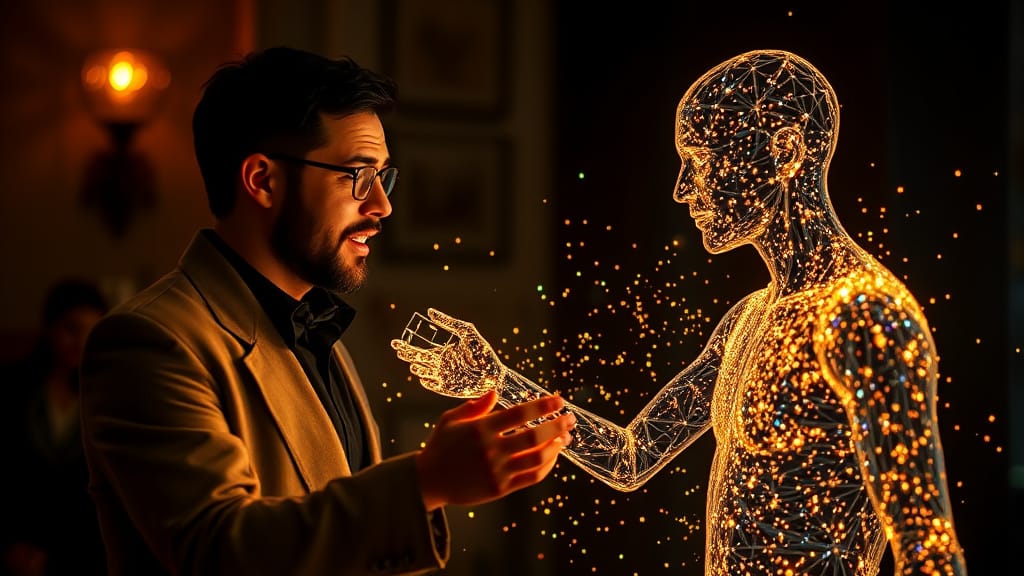
If “Mercy” only opened the door to AI-driven cinema, the project “The Man with a Shattered World” will be a full-scale invasion. Based on the true story of psychologist Alexander Luria, who in the 1920s worked with a soldier suffering from a severe traumatic brain injury, this film will be created almost entirely by neural networks.
Key features of the project:
- Only one live actor: A professional performer (name not yet disclosed) will interact with fully AI-generated characters.
- A digital world: The environment, details, and atmosphere will all be created by neural networks.
- Philosophical foundation: Bekmambetov draws a parallel between Luria’s work of “reprogramming” a patient’s brain and training AI, calling the scientist “the father of artificial intelligence.”
Bekmambetov’s View: Balancing Technology and Humanity
Despite actively integrating AI into filmmaking, the director maintains a balanced perspective on the technology:
“AI is inevitable, and our task is to learn to use it responsibly. But it will never completely replace creative people. The magic of a live actor, that unpredictable spark that happens on set—that is something algorithms cannot fully reproduce.”
Bekmambetov envisions a future where actors might train their own AI models, creating digital doubles for work in new formats and platforms. In his view, AI will become not a replacement, but an extension of creative possibilities.
Comparative Analysis of Bekmambetov’s Projects
| Project | Status | Role of AI | Cast | Expected Release |
|---|---|---|---|---|
| “Mercy” | Post-production, release on 23.01.2026 | Film’s theme, pre-visualization tool | Live actors (Chris Pratt, Rebecca Ferguson) | 2026 |
| “Stanislavsky” System | Technology, launch in December 2025 | Content creation and collaboration tool | Virtual actors trained using the method | Launch in 2025 |
| “The Man with a Shattered World” | In development | Primary creator (generates actors, world, action) | One live actor + AI characters | Not announced |
What This Means for the Industry
Bekmambetov’s experiments could lead to significant changes in the film industry:
- Cost Reduction: AI pre-visualization and content generation will significantly lower budget requirements for complex projects.
- New Creative Possibilities: Directors will be able to experiment with visual styles and narrative forms previously inaccessible.
- Ethical Questions: The use of AI actors raises issues regarding rights, authorship, and the future of the acting profession.
- Democratization of Production: Small studios and independent directors will gain access to tools once available only to major studios.
While many in the industry view AI with caution, Bekmambetov sees it as a new artistic tool, comparable in significance to the transition from silent films to sound or from film to digital. His projects are not merely technological experiments but an attempt to rethink the very nature of cinematic storytelling in the age of artificial intelligence.
The question remains whether audiences will embrace films created by algorithms. However, one thing is clear: Timur Bekmambetov is already paving the way to a future where the boundaries between human creativity and machine generation are becoming increasingly blurred.