Architects of the New Era: Time Recognizes AI Creators as 2025 Persons of the Year
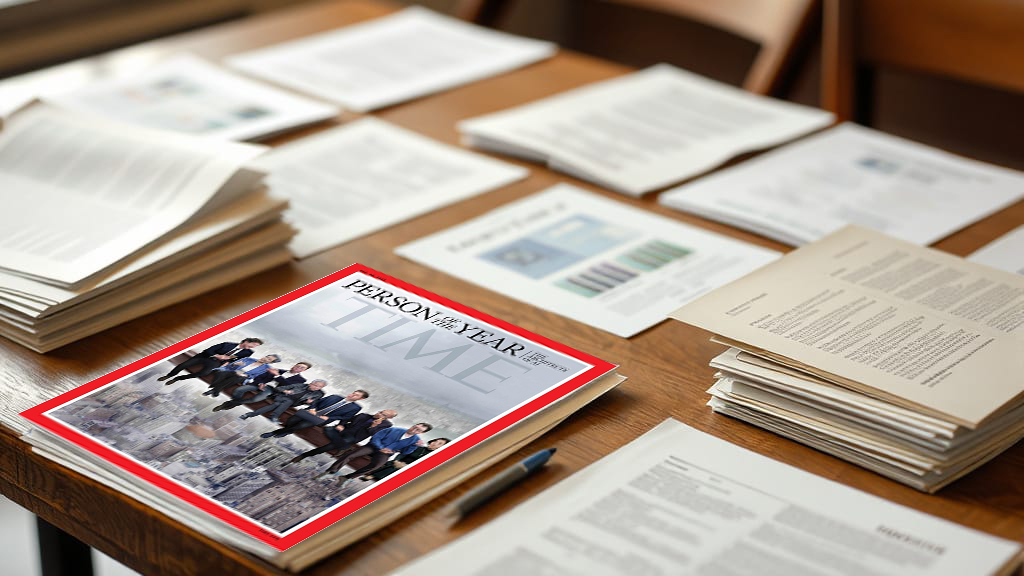
Artificial intelligence has moved beyond laboratories and become the defining factor of the year — according to the editors of Time magazine, who in 2025 opted not to select a single individual. The magazine awarded the title “Person of the Year” to a group of prominent leaders and engineers, calling them “The Architects of AI.”
Among them are the heads of leading technology companies and labs: Mark Zuckerberg (Meta), Lisa Su (AMD), Elon Musk (xAI, SpaceX, Tesla), Jensen Huang (Nvidia), Sam Altman (OpenAI), Demis Hassabis (DeepMind), Dario Amodei (Anthropic), and Fei-Fei Li (ImageNet, Stanford).
A key symbol of this choice is the cover, created by digital artist Jason Seiler, which references the famous 1932 photograph “Lunch atop a Skyscraper” showing construction workers on a steel girder. However, this time, seated at a dizzying height are not the builders of Rockefeller Center, but leaders of the modern tech industry.
A Pivotal Year: When AI Became Reality
Time Editor-in-Chief Sam Jacobs explains the choice this way: “This year was the time when the full potential of artificial intelligence came crashing down on us, and it became clear there is no turning back.”
Forrester analyst Thomas Husson called 2025 a “tipping point” for the mass adoption of AI. He stated that the technology is spreading “much faster than the internet or mobile technologies in their time,” and now most consumers use it, often without even realizing it — it is integrated into devices, programs, and services.
Market dynamics are illustrated by the speed of technology adoption. For example, OpenAI’s chatbot, according to September 2025 data, is used by approximately 700-800 million people weekly. Companies are investing billions of dollars in developing AI and its infrastructure.
More Than Just Names: What’s Behind the Cover?
Time‘s choice is not a ranking but a thematic narrative about the driving forces of the technological revolution.
- Symbolism of the Cover: The image of construction workers on a girder is not accidental. It emphasizes that, despite the abstract nature and power of AI, it is still built by human effort. They are in the “air” — an environment of risk and uncertainty.
- One Choice, Two Covers: In addition to the painted portrait of the eight leaders, Time released a second, conceptual cover by illustrator Peter Krauter. It features the letters “AI” embedded in a complex, chip-like structure being built by workers on scaffolding. The same key figures are lost among them — a metaphor showing that even leaders are just part of a giant, constantly evolving ecosystem.
- A Clear Message: As Jacobs notes, “This year, the debate on how to use AI responsibly gave way to a race to implement it as quickly as possible.” The editorial team highlights the duality of the moment: never since the “Gilded Age” (a period of rapid U.S. economic growth in the late 19th century) has so much power been concentrated in the hands of such a small group of people, which brings both accelerated progress and the risks of vast inequality.
Power, Responsibility, and the Unknown
Time‘s recognition acknowledges colossal influence, but not unequivocal approval. Fountech AI lab founder Nikolas Kairinos notes: “At this moment, artificial intelligence can still turn out to be either a savior or a threat to humanity… Recognition should not be confused with readiness.”
Other experts share this skepticism. Executive Director of the Future of Life Institute, Anthony Aguirre, which focuses on AI safety, stated: “Leading AI companies are feverishly working to replace humans in all areas of life… The impact on our society could be catastrophic without safeguards.”
Historical Context: Not the First Time Technology is Recognized
Time‘s decision to name “The Architects of AI” Person of the Year is part of a historical continuity. The magazine has previously recognized groups of people, phenomena, and even objects as “Person of the Year.”
- 1982 — “Machine of the Year” (The Computer): The magazine recognized the personal computer, anticipating its societal impact.
- 2006 — “You”: Time highlighted the role of ordinary users in creating internet content and new digital communities.
- Other Examples: In various years, the title has been awarded to American Scientists (1960), Ebola Fighters (2014), and even our planet as an “endangered” entity (1988).
The current decision also echoes a similar choice in 1982 when, alongside the “Machine of the Year,” then-technology leaders Steve Jobs and John Opel were featured on the cover.
In 2025, AI has finally ceased to be the technology of the future and has become a force shaping the present. Time magazine’s recognition of AI’s creators marks the end of this transition but poses the main question for society: how exactly will humanity define the next stage of the journey it has already embarked upon “at full speed, without brakes”?