GDC 2026: The Biggest AI News in Gaming Today
The hottest topic in the gaming world right now is the 2026 Game Developers Conference (GDC) taking place in San Francisco. It’s safe to say that AI has become the undisputed star of this year’s conference, with its influence felt like never before — for the first time in history, the number of sessions dedicated to AI has surpassed 100, a 110% increase from last year.
Major companies have unveiled their latest innovations, showing how AI is reshaping every aspect of gaming, from development tools to the player experience.
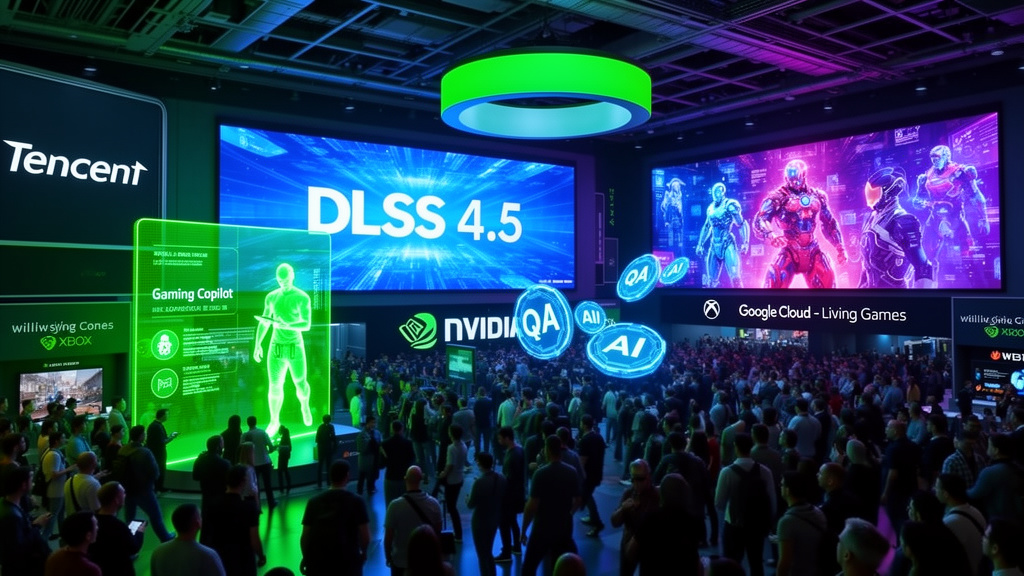
Tencent arguably made the biggest splash with the world premiere of AI-powered martial arts technology. This technology is already being used in the game Hunter: Age of Wonders: AI generates animations in real-time, making character movements smoother, more natural, and solving the problem of “foot sliding.” Additionally, Tencent updated its GVoice voice engine, adding AI-based voice conversion and real-time translation features. They also announced the HY 3D AI Generation engine for accelerated game asset creation. In total, the company is participating in 21 AI sessions at GDC, accounting for 42% of all such sessions among major companies.
NVIDIA, as usual, focused on graphics and performance. They announced DLSS 4.5, which now includes a dynamic multi-frame generation feature. This allows the game to adjust to the target frame rate in real-time, making the most efficient use of the graphics card’s power. They also introduced RTX Video Super Resolution, a tool that helps developers quickly upscale AI-generated video content up to 4K resolution, speeding up the process by up to 30 times.
Microsoft, through Xbox, announced Gaming Copilot — an AI-powered voice assistant built directly into the platform. It will be able to offer game walkthrough tips, help with settings, and answer player questions. In his keynote, the head of Xbox also addressed an important ethical topic, pledging to fight against “soulless AI-generated content” and stating that the company is exploring compensation mechanisms for content creators whose work is used to train AI models.
Razer introduced new tools for developers. Standouts include QA Companion AI, a system that automatically detects physics and rendering errors in a game and creates detailed bug reports with attached video. Their voice assistant, AVA, has also evolved into a more advanced “agentic” assistant capable of performing multi-step tasks. A new adaptive immersion system allows games to control Razer device haptics and lighting in real-time based on in-game events.
Google Cloud shared its vision for the future, presenting the concept of “Living Games.” This refers to games where the world is populated by autonomous AI agents that react to player actions in real-time, making the universe feel truly alive. Furthermore, Google clarified that their previously demonstrated Project Genie is not yet capable of creating fully playable games. The worlds generated with its help only last for about a minute before “breaking down,” and the project is primarily used for researching AI agents.
Overall, the development of AI in the gaming industry is moving forward on several distinct paths. On one hand, technologies like Tencent’s AI martial arts, NVIDIA’s DLSS 5, and Razer’s testing tools are already solving concrete problems, improving development efficiency and game quality. On the other hand, Microsoft’s Copilot and Google Cloud’s “Living Games” concept are opening up new ways for players to interact and defining new forms of gameplay.