
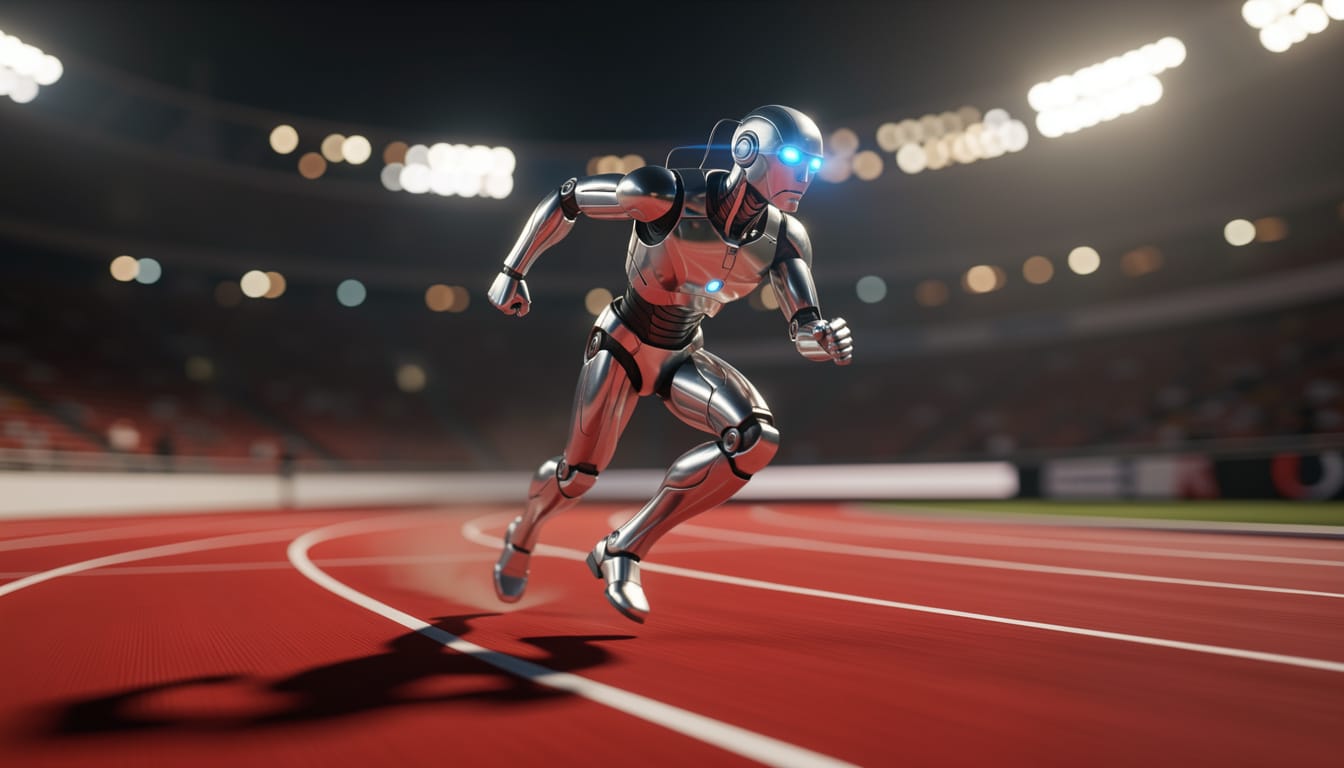
Humanoid Unitree H1 Reaches 10 m/s, and Quadruped “Bai Si” Runs 100 Meters in 16.33 Seconds
A landmark event has occurred in the world of robotics: Chinese developers have simultaneously demonstrated impressive progress in two categories — bipedal and quadrupedal robots have broken world speed records. While some sources report on the achievement of the humanoid robot Unitree H1, others describe the phenomenal result of the quadruped robot “Bai Si” (白巳). Let’s take a closer look at what exactly happened and why these events are important for the industry.
 Humanoid Robot Unitree H1: Almost as Fast as Bolt
 Humanoid Robot Unitree H1: Almost as Fast as Bolt
Record Numbers
On April 11, 2026, Chinese company Unitree Robotics released a video showing its humanoid robot H1 achieving impressive metrics:
- Peak speed — 10.1 m/s (equivalent to approximately 36 km/h)
- Robot weight — about 62 kg
- Leg length — 0.8 meters (comparable to human parameters)
To understand the scale: the legendary Usain Bolt ran 100 meters in 9.58 seconds in 2009, achieving an average speed of 10.44 m/s, with a peak speed reaching 12.42 m/s. Thus, the H1 already runs faster than most ordinary people and is approaching elite athletes.
Interestingly, the tested robot was a “lightened version” — without a head or arms, which reduced weight and improved aerodynamics. The full version of the H1 weighs about 47 kg.
The Path to the Record: From 3.3 to 10 m/s in 8 Months
The most remarkable aspect of this achievement is the speed of progress. As recently as August 2025, at the World Humanoid Robot Games, the best models ran at about 3.3 m/s. In just 8 months, the metric has tripled!
| Date | Event | Speed |
|---|---|---|
| August 2025 | First humanoid robot competitions | ~3.3 m/s |
| February 2026 | Bolt robot by MirrorMe Technology (on a treadmill) | 10 m/s |
| April 2026 | Unitree H1 (on a real running track) | 10.1 m/s |
According to experts, this impressive progress was achieved primarily through improvements in software and control algorithms, not just hardware upgrades. For comparison: the American Tesla Optimus can move at a maximum speed of only 2.7 m/s.
Problems That Remain Behind the Scenes
Despite the impressive numbers, engineers still need to solve a number of serious problems:
- Heat dissipation — when moving at an average speed of 6 km/h (1.67 m/s), the temperature in the H1’s knee joints exceeds 80°C, and torque accuracy drops by more than 20%
- Limited operating time — the maximum speed likely can only be maintained for tens of seconds
- Stability of movement — in the published video, the robot can be seen veering off the straight line, indicating ongoing balance issues
What Is the Company Saying?
Unitree Robotics CEO Wang Xingxing made a bold statement back in March 2026 at a forum in Yabuli: “By mid-2026, humanoid robots will be able to run 100 meters in less than 10 seconds, surpassing Bolt.” Now his words are beginning to take on real shape.
Quadruped Robot “Bai Si”: 100 Meters in 16.33 Seconds
 Quadruped Robot “Bai Si”: 100 Meters in 16.33 Seconds
The achievement of the quadruped robot named “Bai Si” (白巳) deserves special attention. According to some sources, this robot, developed by the Chinese company Unitree (manufacturer of the famous Go series robot dogs), ran 100 meters in 16.33 seconds.
For comparison: the world record among humans for this distance is 9.58 seconds (Bolt). However, it is important to understand that quadruped robots have a different movement kinematics — their “run” is technically closer to an animal’s gallop, and 16 seconds is an outstanding result for a machine of this class.
Why Do Robots Need to Run? Real-World Applications
 Why Do Robots Need to Run? Real-World Applications
When it comes to high-speed robots, many immediately think of military applications. However, experts point to far more pragmatic scenarios:
| Scenario | Description |
|---|---|
| Search and rescue operations | A robot can rush into an earthquake zone, explosion site, or toxic gas leak at 10 m/s, where a human physically cannot be present |
| Industrial inspections | Fast patrolling of large areas — ports, warehouses, logistics centers |
| High-speed sorting | Fast-running control technologies can be adapted for precise and high-speed manipulations in manufacturing |
As analysts note, the key value of 10 m/s is not the speed itself, but the fact that it demonstrates the achievement of a critical threshold of dynamic control. A robot that can maintain its balance while running at full speed has fundamentally higher-level control systems than models that can only walk slowly.
Context: The Race and the IPO
 Context: The Race and the IPO
It’s worth noting that the H1’s achievement did not appear in the public space by chance. In March 2026, Unitree filed for an IPO on the Shanghai Stock Exchange. According to estimates, with a 10% placement and plans to raise 42 billion yuan, the company’s market capitalization could reach at least 420 billion yuan.
A telling fact: the Bolt robot from MirrorMe Technology achieved similar results back in February 2026 but received significantly less media attention. The difference in interest is easily explained — Unitree has a commercial track record that requires constant demonstration of technological leadership.
What’s Next?
 What’s Next?
Already on April 19, 2026, the Second Humanoid Robot Half Marathon will take place in Beijing. More than 300 models are expected to participate, and analysts predict that this year we will see several robots capable of running side by side with humans.